October 29, 2026
How to Choose 190T Polyester Tent Fabric: An OEM Sourcing and Inspection Guide to the Workhorse Specification of Global Camping Tents
A practical OEM sourcing guide to 190T polyester taffeta for camping tents: what the T number really measures, how 170T, 190T, 210T and 210D Oxford compare on strength, waterproofing and cost, the 40HQ loading economics, and the four inspection checks buyers should lock into the contract.
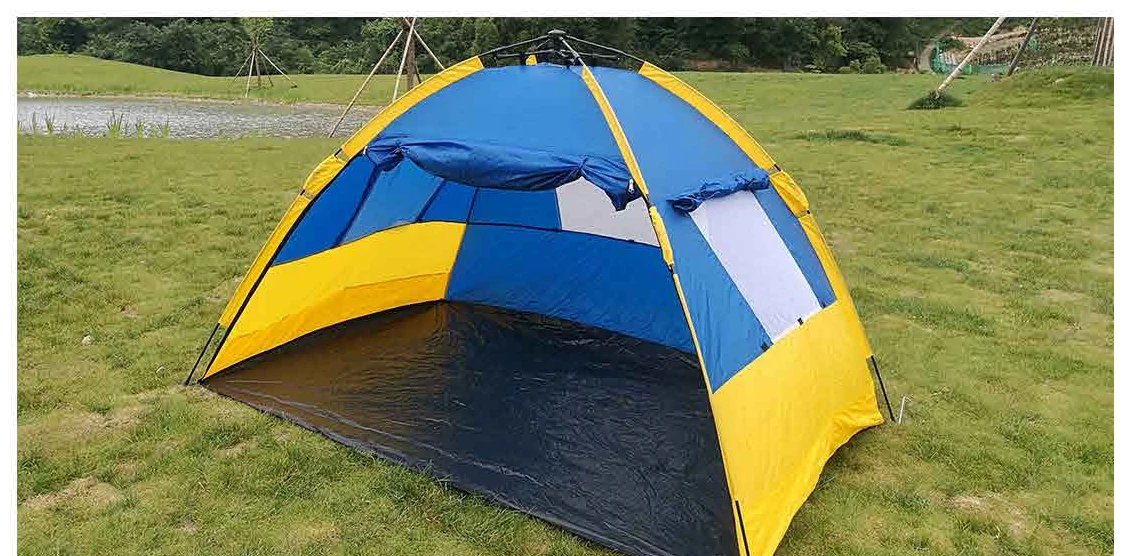
Of the millions of camping tents shipped around the world every year, the specification line overseas buyers see most often is undoubtedly “190T Polyester PU 2000mm”.
Whether on the family tent shelves of large European outdoor retail chains or on the bestseller lists of mainstream marketplaces in Europe and North America, 190T polyester holds a firmly dominant position. Yet many brand buyers are still confused when they specify and inspect: why does one 190T sample feel thick and crisp while another is thin as a whisper? And how does it actually differ from entry-level 170T or from higher-grade 210T and 210D Oxford in physical strength, container loading and manufacturing cost?
Drawing on the production standards of Ningbo Xinqiu Tourism Products Co., Ltd. (XINQIU TENT, a 20-year tent factory, BSCI audited), this article explains the underlying mechanism that made 190T polyester the cornerstone specification of the global camping tent industry, and gives B2B buyers practical inspection points that prevent costly mistakes.
1. What is real 190T polyester?
“T” (Taffeta Density) is the textile unit that measures warp and weft weave density. 190T means that within one square inch (1 inch × 1 inch) of fabric, the number of warp yarns and weft yarns combined is about 190.
In the standard process specification at Xinqiu, a typical 190T polyester taffeta structure is built as follows: 100% premium virgin semi-dull polyester filament (Polyester FDY 68D/24F or 75D/36F); an actual weave of roughly 105–108 yarns per inch in the warp and 84–86 yarns per inch in the weft, giving a theoretical density total of 189T–194T.
The physical weight matrix is just as specific: greige fabric before coating 58g/m² ± 3g/m²; finished fabric (dyed + PU 2000mm coating + water repellent) 70g/m² ± 4g/m².
Factory insight: why does 190T from different subcontractors differ so much in weight and thickness?
This is the blind spot where overseas buyers most often get caught: the assumption that once “190T” is written on the specification sheet, every factory will deliver exactly the same fabric. That is completely wrong.
The “T” number measures only the number of yarns per square inch. It places no requirement at all on the thickness of an individual yarn (Denier).
High-quality factory standard (the XINQIU specification): coarser, tougher virgin polyester filament of 68D/24F or 75D/36F is woven into 190 warp and weft yarns, so the greige fabric reliably reaches 58–62g/m², feels substantial and resilient in the hand, and its warp and weft tensile and tear strength sit well above the industry baseline.
Low-price tender workshops: to push quotations down they deliberately weave the same 190 yarn density from 50D or even finer yarn. Counted under a density lens the yarns “are indeed 190”, but because each yarn is too fine the greige weight often collapses to 48–52g/m² and the surface is thin as a whisper. Under strong sun and wind load, tear strength falls off a cliff, and at the stitch holes severe seam slippage appears: yarns shift apart and open larger holes, rain leaks through the needle holes, and in strong wind the seam can simply burst open. Professional B2B sourcing therefore must never check “190T” alone; the purchase contract and technical specification have to lock in both the yarn denier (for example 68D/75D) and the actual weight per square metre (g/m²).
2. 170T vs 190T vs 210T: a side-by-side performance comparison
The comparison below covers the four specifications buyers most often weigh against each other. All figures are typical production ranges rather than laboratory extremes.
- 170T polyester (entry / shade grade): finished weight 48–52g/m², warp tensile ≥ 320 N, weft tensile ≥ 260 N, tear ≥ 12 N, PU 400–800 mm, UPF 30+ after silver coating, about 400 abrasion cycles, cost index 1.0; positioned for pop-up tents, beach shade and inner tents.
- 190T polyester (camping workhorse / balanced grade): finished weight 68–72g/m², warp tensile ≥ 460 N (+43%), weft tensile ≥ 380 N (+46%), tear ≥ 19 N (+58%), PU 1500–3000 mm, UPF 30+ to UPF 50+, about 900 abrasion cycles, cost index 1.22; positioned for the flysheets of 2–4 person camping tents and for family tents.
- 210T polyester (storm-grade high density): finished weight 78–84g/m², warp tensile ≥ 580 N, weft tensile ≥ 490 N, tear ≥ 26 N, PU 2000–5000 mm, UPF 50+, about 1400 abrasion cycles, cost index 1.48; positioned for four-season alpine tents and storm-proof flysheets.
- 210D Oxford (heavy-duty drive-away grade): finished weight 135–150g/m², warp tensile ≥ 720 N, weft tensile ≥ 650 N, tear ≥ 42 N, PU 2000–5000 mm, UPF 50+, more than 2500 abrasion cycles, cost index 1.85; positioned for tailgate extension tents, large tunnel tents and outer covers.
Conclusion: compared with 170T, 190T adds only about 22% to raw material cost, yet its tensile and tear strength jump by roughly 45%–58%, which is enough to withstand force 5–6 gusts in the field.
3. Waterproof coating and hot-air seam taping
Weave density is the skeleton; the downstream coating and the hot-air taped seam are what determine the service life of the waterproofing.
- PU gradient coating: PU 1500mm–2000mm (the standard for European and American camping): a two-pass precision knife coating lets polyurethane resin molecules penetrate evenly into the gaps between fibres, blocking sustained moderate-to-heavy rain while keeping the fabric light and soft, and it does not stiffen when packed at 0°C. PU 3000mm (a mid-to-high-end custom upgrade): an added hydrolysis-resistant base coat for wet, windy marine climates such as the UK, New Zealand and Northern Europe; the water-based, environmentally friendly formulation meets EU REACH requirements.
- Double-needle stitching and hot-air waterproof tape: High-tenacity bulked polyester thread is used at the seams; the reverse side then passes through a fully automatic hot-air taping machine that fuses premium transparent PU tape (20mm wide, 0.08mm thick) over the stitch holes at a constant 165°C–175°C; tape peel strength is sampled at ≥ 8 N/25mm for every batch, so that the tape does not bubble or lift after one to two years of use.
- Outer DWR lotus-effect water repellency: The face fabric receives an environmentally friendly, PFC-Free and wash-resistant water-repellent finish; spray testing reaches AATCC 22 grade 4 (Spray Rating ≥ 90), so rain beads up and rolls off and the fabric neither absorbs water nor gains weight.
4. Container loading and packaging economics (40HQ)
The comparison below is measured on a classic 4-person double-layer family dome tent (open size 240×210×140cm, fitted with 8.5mm fibreglass poles and a 120g/m² PE floor).
- Packed size per tent: plan A, 170T polyester, 56 × 14 × 14cm; plan B, 190T polyester, 58 × 15 × 15cm; plan C, 210D Oxford, 68 × 22 × 22cm.
- Master carton (4 tents): plan A 58 × 30 × 30cm; plan B 60 × 32 × 32cm; plan C 70 × 46 × 46cm.
- Gross weight per tent: plan A 2.85kg; plan B 3.45kg; plan C 5.80kg.
- Tents per 40HQ: plan A about 4800; plan B about 3800; plan C about 1800.
- Ocean freight per tent at $3500 per container: plan A $0.73; plan B $0.92; plan C $1.94.
- Overall weather rating: plan A for daytime park use (wind resistance up to force 4); plan B all-season camping (wind force 5–6, storm rain); plan C heavy-duty camps (wind force 7 and above).
Economics conclusion: 190T ships a stable 3800 tents per 40HQ at only $0.92 of ocean freight per tent. It withstands wind and rain with a very low return rate while keeping logistics cost in a sensible band, which is exactly why it is the golden specification with the largest shipping volume for large overseas retailers.
5. Four sourcing and inspection rules for B2B buyers
- Beware hidden weight loss from the same density with thinner yarn: Some subcontractors exploit the fact that the T number counts yarns but ignores thickness, weaving 190 warp and weft yarns from 50D fine yarn, which drops the weight to 48–52g/m² and cuts strength by 25%–35%. Sourcing defence: write into the purchase contract and the Tech Pack “190T 68D/24F (or 75D/36F) Polyester, Base Weight ≥ 58g/m², Finished Weight ≥ 70g/m²”; at inspection, die-cut samples with a 100cm² circular cutter, weigh them, and firmly reject any lot whose uncoated base fabric is below 55g/m².
- Beware 170T passed off as 190T: The 100cm² die-cut weighing method confirms it in seconds: 170T greige fabric is normally below 50g/m².
- Hydrostatic head after repeated flexing: Measure how far hydrostatic head falls after 500 mechanical flex cycles; a good 190T PU 2000mm fabric should not lose more than 20%.
- Cross-ventilation design: 190T is a high-density windproof and waterproof fabric, so the tent must be given cross-flow side vents, or a two-layer structure of “190T flysheet + mesh inner tent”, to prevent condensation inside the tent.
Manufacturing capability and custom parameters: base fabric 100% polyester 190T taffeta (105T warp / 85T weft, 58g/m² base weight); coating options PU 1500mm, PU 2000mm and PU 3000mm, heat-reflective silver coating (UPF 30+ to UPF 50+), titanium-silver coating, and optional CPAI-84 or EN ISO 6941 flame-retardant finishing; colour and print: Pantone spot dyeing, high-precision digital heat transfer or water-based screen printing; hardware matching: 7.9mm, 8.5mm and 9.5mm latex-threaded fibreglass poles with galvanised chamfered ferrules, matched with a 110–130g/m² double-sided laminated PE groundsheet or a 150D/210D Oxford PU 3000mm groundsheet.