1. Diameter Mechanics: The 6.9mm to 12.5mm Selection Matrix
In tent structural engineering, a pole's flexural rigidity scales with the fourth power of its outside diameter. Adding a single millimetre of diameter raises wind bending capacity exponentially, but it also raises packed weight for the whole tent.
To give brand buyers and product managers a clear basis for range planning, XINQIU maps the common diameters against recommended span and wind rating as follows.
| Outside diameter (mm) | Reference wall (mm) | Weight (g/m) | Recommended span | Typical tent type and structural role | Max wind (Beaufort) |
|---|---|---|---|---|---|
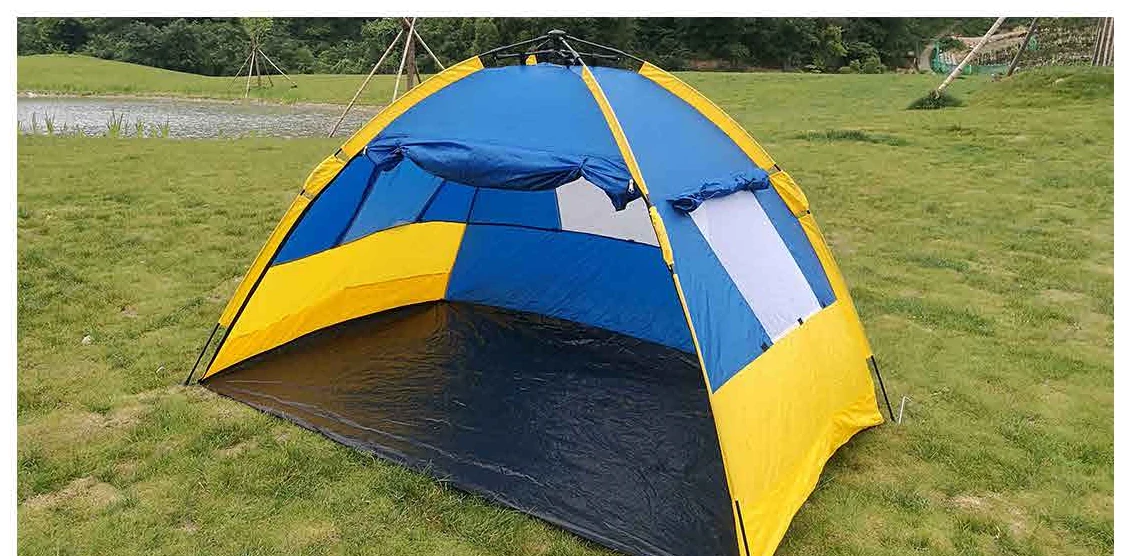
| Φ 6.9 | 1.3 - 1.5 | ~58 | 1.2 - 1.8 m | Solo lightweight dome tents, secondary poles on beach shades, children's play tents | 3 - 4 (light breeze) |
| Φ 7.9 | 1.6 - 1.8 | ~78 | 1.8 - 2.4 m | Classic main pole for 2-3 person dome tents | 4 - 5 (gentle breeze) |
| Φ 8.5 | 1.8 - 2.0 | ~95 | 2.2 - 2.8 m | 3-4 person double-cross dome tents, reinforced main pole on instant family tents | 5 - 6 (strong breeze) |
| Φ 9.5 | 2.0 - 2.2 | ~125 | 2.6 - 3.2 m | Centre arches of 4-6 person tunnel tents, uprights for utility and shower tents | 6 (strong wind) |
| Φ 11.0 | 2.2 - 2.5 | ~175 | 3.0 - 3.8 m | 6-8 person family camping tents, main frame for SUV tailgate awnings | 6 - 7 (near gale) |
| Φ 12.5 | 2.5 - 2.8 | ~230 | 3.6 - 4.5 m | 8-10 person multi-room group tents, high-peak commercial display shelters | 7 (gale) |
XINQIU engineering rule: never try to span more than 2.4 m with a Φ7.9mm pole. Many small workshops, to shave 1.5 USD off each tent, quietly downgrade a 4-person family model to a 7.9mm pole. The roof then sags because flexural rigidity is insufficient, pools water in wind and rain, and finally fails in a brittle burst under bending overload.
2. What Really Drives Breakage: Virgin E-Glass vs Recycled Resin
Two black-coated fiberglass poles can look identical and measure identical on a caliper, yet differ tenfold in fatigue life on a tensile rig. The difference sits in the composite formulation underneath the paint.
- Purity of E-Glass Fiber: XINQIU standard: continuous high-purity E-Glass untwisted roving with high single-filament tensile strength, strong toughness and excellent recovery, surviving 1,000 repeated flex cycles without fatigue cracks. Low-cost material: chopped recycled waste yarn with high- or medium-alkali content, where discontinuous filaments generate micro-stress fractures under load.
- Resin Matrix and Curing: XINQIU standard: modified unsaturated polyester resin with a toughened epoxy-polyurethane system, resin content held in the 32%-35% golden wet-out window, delivering both high stiffness and flexible cushioning. Low-cost material: heavy loading with calcium carbonate and other inorganic fillers, which embrittles the resin so it ages and chalks in strong sun and snaps with a dry crack under light hand pressure.
- Pultrusion Temperature Control and Surface Sealing: XINQIU pulls the profile through multiple constant-temperature curing ovens and then sprays a weather-resistant polyurethane protective coating, so the surface stays smooth and burr-free and glass fibre shedding, the worst source of hand-injury complaints, is eliminated.
3. Joint Engineering: Four Anti-Breakage Details
In real use, 80% of fiberglass pole failures do not happen mid-section. They happen at the metal ferrule and the end-tip connections. XINQIU therefore writes four anti-splitting rules into its process records.
- Thick-Wall Chamfered Steel Ferrule: Cheap poles use thin stamped sheet ferrules with knife-sharp cut edges that score the fiberglass wall during bending and trigger a burst. XINQIU ferrules are cold-drawn seamless high-strength steel tube with wall thickness of 0.8mm or more, and both inner and outer end faces are CNC de-burred and chamfered to remove the stress concentration that starts a split.
- High-Strength Deep-Pressed Locking Dimples: Ferrule and pole are fixed by four symmetrically deep-pressed dimples that withstand more than 50kg of axial pull without any adhesive creep or loosening.
- Oversized Age-Resistant Latex Shock Cord: The internal cord is multi-strand natural latex sheathed in a high-abrasion polyester braid of 2.8mm diameter or more, with 150% elongation, so it stays soft in -20℃ cold through repeated packing instead of hardening and snapping, and lets the end consumer assemble the frame blind in seconds.
- Precision End Tips in moulded Plastic or Zinc Alloy: Both pole ends carry a precision moulded cylindrical tip or a solid zinc alloy point, which seats easily into the corner grommet and protects the hollow tube wall from splitting when it strikes gravel on the ground.
4. Field Test Guide for Sample Approval and Inspection
When a sample arrives or a pre-shipment inspection (PSI) is carried out, buyers can judge the real quality of a fiberglass pole in four quick steps.
- 180 Degree Elastic Deflection Test: Take one full pole section, grip both ends and bend it inward until the ends are only one third of the original length apart, forming close to a 180 degree arc. Hold 30 seconds and release. Pass standard: no cracking sound, natural spring-back within one second, straightness deviation under 3mm. Any cracking or permanent set means the batch is rejected.
- Axial Load Test at the Ferrule Edge: Under large deflection, check that the transition between ferrule edge and pole wall is smooth, with no cutting mark or bite into the fiberglass.
- Surface Fibre Hand-Safety Check: Grip the pole with a dry paper towel and slide it fast from one end to the other. The paper must show no pulled fibre fuzz, and the surface must feel smooth to the finger with no pricking sensation.
- Ferrule Pull-Off Test: Hold the ferrule and the pole end and twist-pull in opposite directions. At 400N (about 40kg) the ferrule must show no micro-movement or loosening.
5. Summary and OEM / ODM Frame Customization
A camping tent is a precision mechanical system of soft and hard parts. The fabric sets the lower limit of weather protection, while the frame specification sets the upper limit of storm the tent can survive. Choosing the right diameter, virgin E-glass roving and a finely chamfered ferrule is the core know-how for building high wind resistance at controllable cost.
Ningbo Xinqiu Tourism Products Co., Ltd. (XINQIU TENT) brings 20 years of OEM manufacturing for global brands and is BSCI audited. The factory holds the full range of Φ6.9mm, 7.9mm, 8.5mm, 9.5mm, 11mm and 12.5mm high-grade fiberglass poles in stock, and supports Custom manufacturing of aluminium ferrules, colour anodised finishes, quick self-opening automatic frames and full aluminium pole upgrade programmes.