Tent Zipper Specifications: Coil vs Vislon, and Why Sand Kills Coil Zips
Zippers are the cheapest component on a tent and the second most common warranty claim after poles. In sandy and dusty markets the failure is predictable, and it is decided at specification stage.
A zipper costs a few percent of a tent's bill of materials and drives a disproportionate share of returns. In Gulf, North African, Australian and South American markets the dominant failure is not tearing — it is abrasion from wind-blown sand lodging in the tape and teeth, which raises slider friction until the pull tab fails or the wearer forces the zip and strips the teeth.
1. Coil vs Moulded Tooth: What Actually Differs
A coil zipper is a continuous spiral of monofilament stitched to the tape; a moulded-tooth zipper (the best-known example being YKK VISLON) has individual plastic teeth injection-moulded onto the tape. Coil is lighter, more flexible and better around curves — which is why it dominates tent doors and sleeping bags. Moulded tooth is stiffer, holds a line, and resists lateral separation better. Both are available from multiple suppliers; neither is inherently "better".
2. Why Sand Defeats a Coil Zip
The coil's advantage — flexibility — is also its weakness. Particles that would sit on top of a moulded tooth can lodge in the gap between coil elements, and because the coil deforms under load it can close around the grit. The result is progressive: friction rises, the slider leans, the tape distorts, and eventually the zip either jams or jumps. Moulded-tooth zips shed more grit but still fail if the slider is not protected and the tape is not covered.
3. Five Specification Levers
Tooth size. Larger tooth numbers carry higher lateral load. Specifying a size 5 coil where a size 8 is needed is a common cost-down that shows up as field failure on large doors.
Slider design. An auto-lock slider prevents the zip creeping open in wind; a slider with a large, glove-friendly pull reduces the force a user applies, which is what strips teeth.
Storm flap. A covered zip — a flap of fabric standing between the teeth and the outside — is the single most effective sand defence, and it is cheap. Where the design allows, specify it.
Tape. Tape stiffness and finish matter: a limp tape folds into the slider. Ask for the tape construction, not just the tooth type.
Zipper garage. A garage at the top of the zip stops grit entering the park position and prevents the flap snagging.
4. The Test That Predicts Returns
Ask for a slider-friction measurement before and after an abrasion cycle — typically a dust or sand tumble followed by a defined number of open/close cycles, recording the force needed to move the slider. A zip that starts at low force and stays low is a zip that survives a sandy season. A zip specified only as "YKK" or "size 5 coil" has no measurable acceptance criterion, so nothing can be rejected at inspection.
5. Where Zips Sit in the Warranty Picture
A practical mitigation used on container-level OEM orders is a spare parts kit of 1–2% per container covering zippers, sliders and hooks. It does not substitute for correct specification, but it lets a retail partner resolve a field issue in days instead of waiting on a replacement shipment — which is often the difference between a one-star review and no review at all.
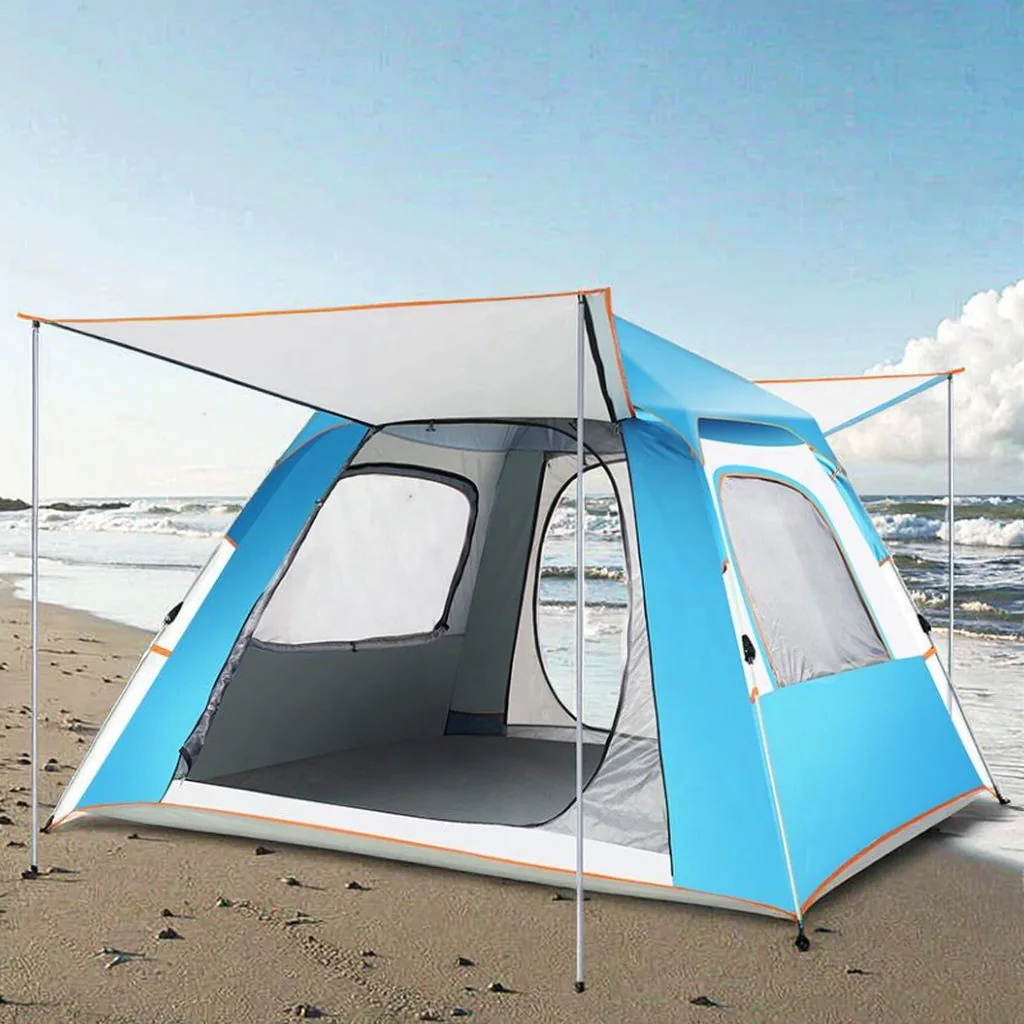
Every unit we ship goes through 100% post-assembly inspection including zipper function, before it is packed.
6. Choosing Between Coil and Moulded Tooth for Your Market
There is no universal answer, and a supplier who gives you one is simplifying. Coil zippers remain the right choice for lightweight packs, curved openings and sleeping bag construction, where flexibility and low weight dominate and the zip is not the primary weather seal. Moulded-tooth zippers are the better starting point for large main doors, straight runs and high-dust environments, because grit is less likely to lodge and the slider holds alignment longer under load. Where a tent is sold into both a temperate and a sandy market, the pragmatic approach is to keep the same body and specify a different zip, flap and slider package for the sandy version — a change that alters cost modestly but moves the failure rate substantially.
It is also worth distinguishing a zipper that has failed from one that has been forced. Field returns in dusty markets frequently show a zip whose teeth are intact but whose pull tab or slider body has deformed — evidence of a user applying leverage to a stiff zip. A larger, glove-friendly pull and a smoother slider reduce the temptation; that is a cheap design change with a measurable effect on returns.
7. Installation Quality Is Half the Specification
A premium zip sewn badly underperforms a mid-range zip sewn well. Three installation variables decide the outcome. Stitch alignment: the zip tape must run parallel to the panel edge along its full length, or the slider fights the tape at every stroke. Tension at the seam: over-tensioning stretches the tape and distorts the teeth before the tent is ever pitched. Corner and curve handling: a coil zip can be set around a curve, but the curve radius has a limit past which the slider will not pass smoothly; a supplier who does not check this during sampling will find it in production. All three are visible on a finished unit, which is why zipper function should be an explicit line item on the 100% post-assembly inspection checklist rather than something the packer notices.
8. Writing the Zipper Into the Purchase Order
A specification you can inspect, in the order it should appear: tooth type (coil or moulded); tooth size number; tape construction and finish; slider type (auto-lock or non-lock) and pull design; storm flap present or absent, with its width; zipper garage present or absent; and the acceptance test — the before/after abrasion friction figure described above. Leave any of these out and the factory will make a reasonable choice on your behalf, which is usually the cheapest reasonable choice.
Specify tooth size, slider, flap and a friction test. Sand is not a design problem — it is a specification problem.
9. Three Mistakes Buyers Make With Zipper Specifications
The first is specifying a brand instead of a construction. Naming a well-known zipper maker does not define tooth type, size, tape or slider, and it does not prevent substitution deeper in the order. The second is using one zip specification for every market — the package that performs in a temperate market at a comfortable price can be the wrong package for a market where wind-blown sand is a daily condition, and the cost difference is small compared with the returns difference. The third is leaving zipper function off the inspection checklist, which means the last person to touch the tent before it is packed has no instruction to open and close the zip they are packing. All three are specification omissions, not manufacturing failures, and all three are fixed on paper rather than in the factory.
Component reference: YKK's own comparison of coil, metal and VISLON zipper types. UV and coating performance for the surrounding fabric follows ASTM D6603.