210D or 150D Oxford Fabric: How to Choose? An OEM Material Guide for Tent Shells, Floors and Heavy-Duty Applications
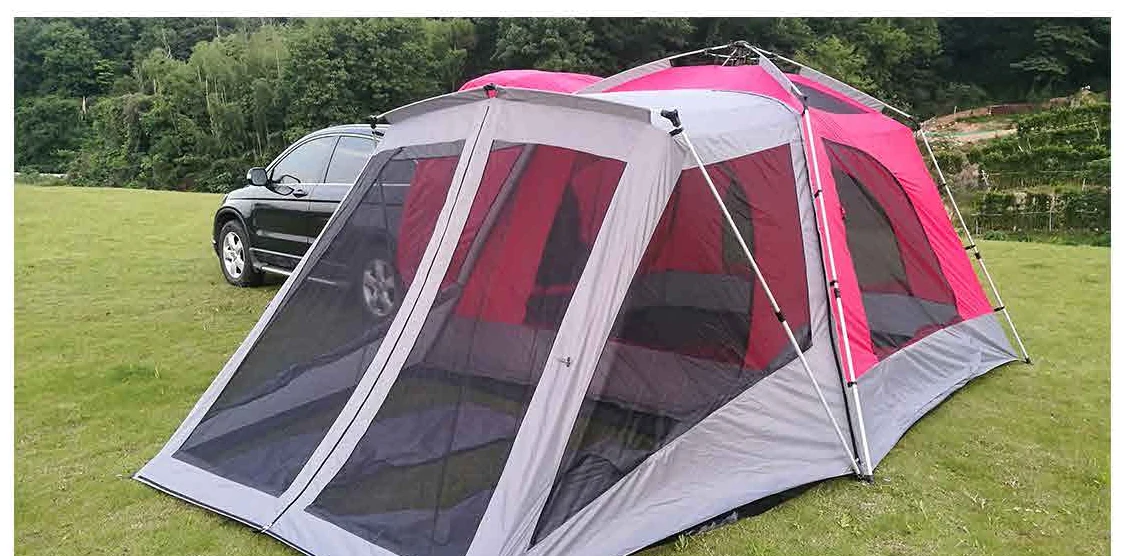
For tent buyers, fabric specification is not simply a question of which number is larger. 150D, 210D, 300D, 420D and 600D Oxford fabrics can all be used in outdoor products, yet the tent structures, use scenarios and cost ranges they suit are quite different.
Chasing the thickest available fabric increases weight, packed volume and purchasing cost. Choosing a fabric that is too thin in order to reduce cost can, in turn, fail to meet the abrasion resistance and structural stability that large tents, SUV tailgate tents and engineering tents require.
Drawing on the actual manufacturing range at XINQIU TENT, this article explains how 150D and 210D Oxford fabric are typically used in tents, and how buyers should match the shell, the floor, the coating system and the product structure.
1. What does the D number actually mean?
The D in a fabric name is a specification marker for yarn thickness. As a general rule, when the weave and finishing conditions are similar, a higher D number means a thicker yarn, and the fabric will usually be heavier and more abrasion resistant.
The D number alone, however, does not determine tent performance. The factors that really shape the finished product also include:
- Warp and weft density and the weave structure;
- Whether a ripstop grid is used;
- The type of PU, UV-resistant or blackout coating;
- Seam sealing tape and the stitching process;
- Whether the fabric is used for the shell, the floor, the skirt or a carry bag;
- Tent footprint, pole structure and the expected use environment.
When sourcing, then, the question should not be whether 210D is better than 150D. The first question is where on the tent that piece of fabric will sit.
2. Which parts of a tent suit 150D Oxford fabric?
150D Oxford fabric balances weight, softness and durability, and is commonly used in the following positions:
- Mid-to-high-end tent floors: With a PU waterproof coating and taped seams, 150D Oxford can serve as a softer and quieter floor solution than a standard PE floor. It suits family camping tents, instant tents and changing tents where the brand wants to improve hand feel and product positioning.
- Lightweight shells and extension rooms: For shade shelters that do not need a heavy-duty structure, lightweight changing tents and roof tent extension rooms, 150D keeps finished weight under control while still offering good durability.
- Storage and auxiliary structures: 150D can also be used for pole sleeves, wind skirts, dividers or carry bags on some tents. Whether it is suitable in a given position depends on the stitching method and the loads that position carries.
The advantage of 150D is that it is lighter and easier to fold and pack. Its limitation is that on larger tents, or where there is long-term abrasion or high wind load, it needs local reinforcement, a sound pole structure and higher-specification fabric in critical areas.
3. Why is 210D Oxford fabric common in tailgate tents and large tents?
210D Oxford fabric uses a thicker yarn and suits products with higher demands on abrasion resistance, tensile strength and structural support. Within the XINQIU TENT manufacturing range, 210D is commonly used for:
- Multi-room family tunnel tents;
- SUV tailgate tents and drive-away camping extension tents;
- Changing, shower and multi-purpose privacy tents;
- Windbreak panels and tents for engineering use;
- Mid-to-high-end Oxford fabric floors;
- Roof tent extension rooms, outer covers and heavy-duty carry bags.
A large tailgate tent, for example, has to connect to the vehicle body and in use is exposed to wind load, guy line tension, friction during pitching and frequent folding. Such structures are usually better served by 210D Oxford than a standard two-person camping tent, combined with a higher waterproof-rated PU coating, taped seams and thicker fiberglass or steel poles.
210D is not a top specification that every tent must use. For beach tents, children's tents or small portable tents where low weight is the priority, a lighter polyester fabric or 150D Oxford is often the more sensible choice.
4. The shell and the floor cannot share one selection logic
4.1 What does the shell need to consider?
The shell faces rain, sunlight and wind over the long term, so sourcing should confirm all of the following at the same time:
- Fabric specification;
- PU waterproof hydrostatic head;
- Whether seams are hot-air taped;
- Whether silver, titanium-silver or blackout coating is required;
- Whether UPF 30+ or UPF 50+ UV protection is required;
- Pole diameter, door and window area, and guy line configuration.
XINQIU TENT offers PU waterproofing from 1000mm to 5000mm, with silver, titanium-silver or full blackout coating selected to suit the scenario. Note that a thicker fabric does not make stitches and seams waterproof by itself; the taping applied after sewing matters just as much.
4.2 What does the floor need to consider?
The floor has to cope with ground moisture, abrasion from grit and stones, and people walking on it. Factories commonly use two approaches:
- PE floor: Double-sided laminated high-density woven PE, suited to family camping and cost-focused orders; it blocks ground moisture and withstands normal grit and stone conditions.
- Oxford fabric floor: 150D or 210D Oxford fabric with a PU 3000mm to 5000mm coating and fully taped seams, softer to the touch and suited to mid-to-high-end products.
If the buyer wants a lighter product that is easier to clean, a PE floor may be the better fit. If hand feel, quietness and a mid-to-high-end position are the priority, an Oxford fabric floor should be evaluated first.
5. When should you upgrade to 300D, 420D or 600D?
For ordinary family camping tents, 150D or 210D usually covers the main requirements. The following cases justify evaluating 300D, 420D or 600D:
- Heavy-duty roof tent outer covers;
- Floor skirts exposed to long-term abrasion and dragging;
- Warehouse-grade engineering tents or temporary facilities;
- Heavy-duty loading bags and transport covers;
- Local reinforcement areas that need higher abrasion resistance.
Before upgrading a fabric, weigh total tent weight, folded size, transport cost, pole load capacity and target retail price at the same time. Simply upgrading every panel to 600D is not necessarily the most economical approach. Many mature projects use a combination design: moderate fabric on the main body, with local reinforcement at the key load-bearing positions.
6. Seven parameters buyers should confirm before placing an order
To reduce repeated sample revisions, it is worth confirming the following at the enquiry stage:
- Tent structure and set-up dimensions;
- Whether the shell uses 150D, 210D or another fabric;
- Whether the floor is PE or Oxford fabric;
- The required PU waterproof rating;
- Whether silver, titanium-silver, blackout coating or UPF protection is needed;
- Whether seams need full taping;
- Pole material and diameter, plus guy line and peg configuration.
XINQIU TENT can match 150D, 210D, 300D, 420D and 600D Oxford fabric to the product application, and offers either PE or Oxford fabric floor options. Fiberglass poles are available in 6.9mm, 7.9mm, 8.5mm, 9.5mm, 11mm and 12.5mm specifications, and steel pole structures support 11mm to 16mm as well as 19mm custom sizes.
7. Conclusion: choose the fabric that fits the structure, not the thickest one
150D suits lightweight shells, mid-to-high-end floors and extension structures; 210D is a better fit for tailgate tents, multi-room family tents, changing and shower tents, windbreak panels and other durable products; 300D, 420D and 600D are mainly used for heavy-duty, high-abrasion or engineering-grade positions.
A reliable OEM solution is not about upgrading every material. It is about making fabric, coating, poles, seams and use scenario match as a complete system. That way real performance is assured while finished weight, packed volume and purchasing cost stay under control.