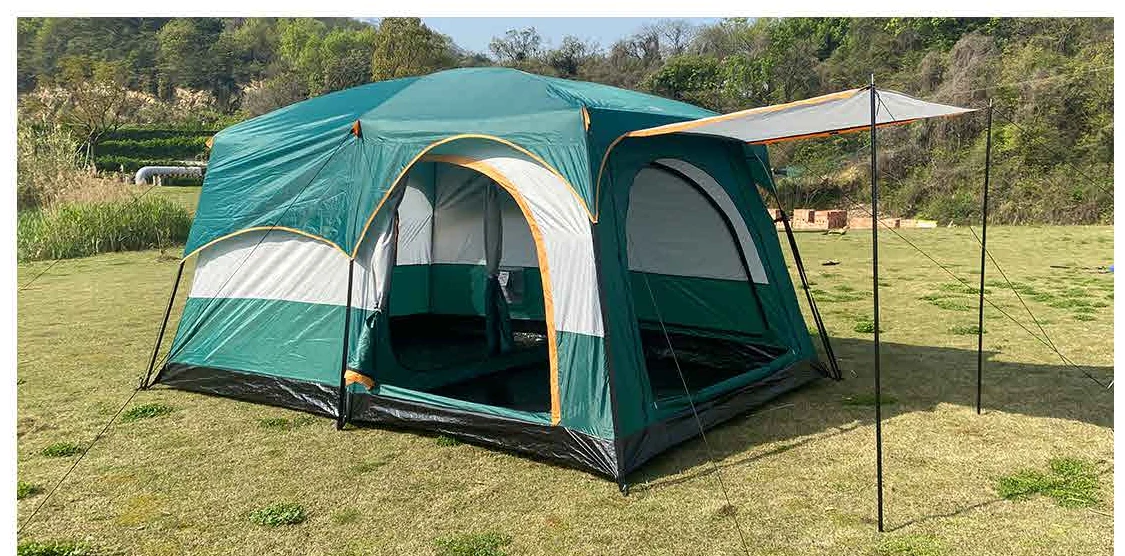
Why tent pegs are the foundation of wind resistance
A tent's wind resistance is not the work of one part alone, but the combined effort of pole + guy line + tent peg:
- The pole holds up the structure and carries wind pressure;
- The guy line transfers wind load from the pole body down to the ground;
- The tent peg drives the guy line's pull into the soil — the end point of the whole load chain.
The four main tent peg types
The factory supports four peg families, covering everything from lightweight portability to heavy-duty wind resistance:
- J-hook plated steel peg: the general-purpose workhorse. The hooked head holds the guy line, the plated finish fights rust and the value is the best — the standard fit on most camping tent models.
- Triangular aviation aluminum peg: the triangular three-sided section adds ground friction, aviation aluminum is light yet strong, so grip and weight saving come together — first choice for mid-high lightweight builds.
- Extended forged cast iron peg: forged in one piece, high rigidity and bend resistance, and the longer shaft drives deeper into hard ground — built for hard soil, frozen ground and heavy-load car tail tents.
- Spiral sand peg: the spiral shaft rotates into sand and increases the bite area in loose media — the dedicated solution for sand, soft soil and beach use.
Material comparison at a glance
The four families differ mainly on the dimensions below. This table is the quick reference we use with buyers when fixing a family camping tent programme.
| Dimension | J-hook plated steel peg | Triangular aviation aluminum peg | Extended forged cast iron peg | Spiral sand peg |
|---|---|---|---|---|
| Material | Plated steel | Aviation aluminum | Forged cast iron | Steel/aluminum spiral shaft |
| Holding power | Moderate | High (triangular section) | High (deep drive in hard soil) | High (bites in sand) |
| Weight | Medium | Light | Heavy | Medium |
| Corrosion resistance | Medium (depends on plating) | High | High | Medium-high |
| Suitable soil | General/grass | Medium-hard soil/grass | Hard soil/frozen ground/heavy load | Sand/soft soil |
| Typical positioning | General value workhorse | Lightweight mid-high end | Heavy-duty wind resistance | Beach/sand specialist |
Note: no single peg covers everything. The core is matching the soil type and wind rating of the target market. A J-hook steel peg is fine for a European forest campsite, while a spiral sand peg is the professional choice for an Australian beach customer; fitting a spiral peg to a hard-ground tent backfires, because the slim shaft bends in hard soil.
Material showdown: steel vs aviation aluminum vs cast iron
The trade-off between the three materials is essentially a triangle balance of weight, strength and corrosion resistance:
- Plated iron: cheap and strong enough, but corrosion resistance depends entirely on the plating — once the coating breaks it rusts, and life is short in permanently damp conditions;
- Aviation aluminum: light, high strength-to-weight ratio, naturally corrosion resistant, but the unit cost is higher, and watch out for fake aviation aluminum (ordinary recycled aluminum passed off as high-strength alloy);
- Forged cast iron: heaviest but with the highest rigidity and the best bend resistance, suited to heavy loads and repeated hammering on hard ground — the price is poor portability.
Soil matching: which peg for which ground
- Grass/soft soil: J-hook steel or triangular aluminum pegs both work, holding power is sufficient;
- Medium-hard soil: triangular aluminum or extended steel pegs, long enough to drive in;
- Hard soil/frozen ground: extended forged cast iron pegs, driven in by sheer rigidity;
- Sand/beach: spiral sand pegs — rotational bite is the key, an ordinary straight peg loosens as soon as it is worked in sand.
Why tent peg geometry matters
A tent peg is not simply a straight stick — the section and head design directly decide holding power:
- J-hook head: holds the guy line without slipping, fast to install;
- Triangular section: three edges instead of a round shaft give more friction area against the soil, so holding power is higher at the same length;
- Extended shaft: the deeper it is buried, the higher the pull-out resistance, which is steadier in hard ground and strong wind;
- Spiral shaft: rotates into loose media and bites through the thread instead of relying on friction alone.
Procurement pitfalls to avoid
- Verify the material: aviation aluminum is not just 'aluminum' — beware recycled aluminum posing as high-strength alloy, and ask for the alloy grade or a tensile test report;
- Check the plating: for plated steel pegs, look at coating thickness and adhesion — thin, flaking plating rusts within one or two seasons;
- Check the forming process: forged cast iron versus stamped and bent sheet steel — the former is one piece and bend resistant, the latter deforms at one hard knock;
- Match length and quantity: short pegs pull out easily in hard ground and strong wind, so confirm the standard peg length and count match the wind rating;
- Match the market: do not fit one universal peg to every programme — selecting by the target market's soil (beach, frozen ground, forest) is what separates a professional OEM.
Conclusion
Tent pegs are the cheapest and least noticeable part of a tent, yet the one that settles the outcome at the critical moment. They decide whether a wind rating is a selling point or empty words, and whether the customer comes back or returns the goods. Ask three questions clearly at OEM specification — material, geometry, soil matching — and your buyer will not pay the tuition for you with a bad review after one night of wind.